Most homeowners might not think much of their insulation. However, it’s vital to help keep the functionality and efficiency of your home. Insulation plays a critical role in keeping your home energy efficient and ensuring that the internal environment is at optimum comfort and temperature.
Whether you’re on the market looking for insulation material for your newly-built home or replacing existing ones, you can refer to this guide to help you find the right one for your space.
-
1. Understand The Different Types Of Insulation
When looking for insulation for your home, you’ll be faced with numerous types in the market to choose from. And to know which type best suits your home, it’s essential to know and understand them. That said, here are some of the most common types of insulation.
Blanket Insulation
This is considered the oldest and most common type of insulation. Blanket insulation can be found in either insulation batts or rolls. They got their name thanks to the blanket-like, fluffy appearance as well as the fact that they cover areas in a blanket-like manner.
Both batts and rolls are typically made of fiberglass; however, you can find ones made of natural fibers, plastic fibers, and mineral wool. And while batts and rolls are often used interchangeably, there are key differences between them.
Insulation rolls are sold as ‘rolls’ and in greater length. This can be challenging in terms of installation, especially if you’re going DIY. In general, you may need to spend time cutting insulation rolls to fit perfectly into your desired space. Insulation batts, on the other hand, are already pre-cut. They are more affordable and easier to install, fitting snugly between trusses and studs.
Both blanket insulation types are suitable for installation in ceilings, attics, unfinished floorings, crawl spaces, and most areas where insulation is needed.
Structural Insulated Panels
Structural insulated panels, more commonly referred to as SIPS, are engineered panels used as construction material for floors, walls, and ceilings. It can be an energy-efficient and durable construction method replacement for traditional lumber framing and insulation.
Of all types of insulation, SIPS has the highest R-value per inch. SIPS-constructed homes are about 50% more energy-efficient than those with traditional framing. It’s also structurally superior (more durable and less prone to shifting) to traditional wood framing. Also, you can find SIPS covered with foil, making it more resistant to moisture.
SIPS features a rigid foam insulation layer in between two structural sheathing materials like oriented strand board (OBS). The panels come in various dimensions and sizes, and you can opt for thickness between 4 and 8 inches. You can check out Raycore.com, if you’re looking to explore this insulation material.
Cellulose Insulation
Like blanket insulation, cellulose insulation is one of the most common insulation types. This is dense, thick, and clumpy insulation material with consistency that’s almost similar to down feathers.
Cellulose insulation may come from any cellular plant source; however, it can also be derived from wood and recycled paper. This makes it an eco-friendly option. In general, cellulose installation is not for the DIYers since you’ll need a piece of special equipment to ‘blow’ it into fill-in areas and cavities. Also, if not professionally sealed, it can be highly prone to mold.
The greatest benefit of this type of insulation is that it allows you to cover hard-to-reach areas and cavities in your home, particularly when insulating pipes. Unlike other types of insulation, it also allows you to insulate key areas such as attics and ceilings without disturbing structures.
Rigid Foam Or Foam Board
Like SIPS, rigid foam or foam board insulation is an innovative insulating material often used during construction. In particular, it’s highly effective as a foundation and roof insulation, and wall sheathing material during construction.
While foam boards are typically recommended during construction, they can also be installed in existing homes. Take note, however, that you’ll need to tear down the area and build it with foam board, making it a time-consuming and expensive option.
In general, foam board insulation is more energy-efficient and offers two times the R-value of other insulation types for the same size and thickness. Also, thanks to its high resistance to moisture, a foam board is suitable for areas prone to getting wet such as your basement and outside of your home.
Rigid foam insulation is also suitable for most DIYers since it’s super easy to install. You will find it in various sizes and can even order a customized one for your building needs.
Spray Foam Insulation
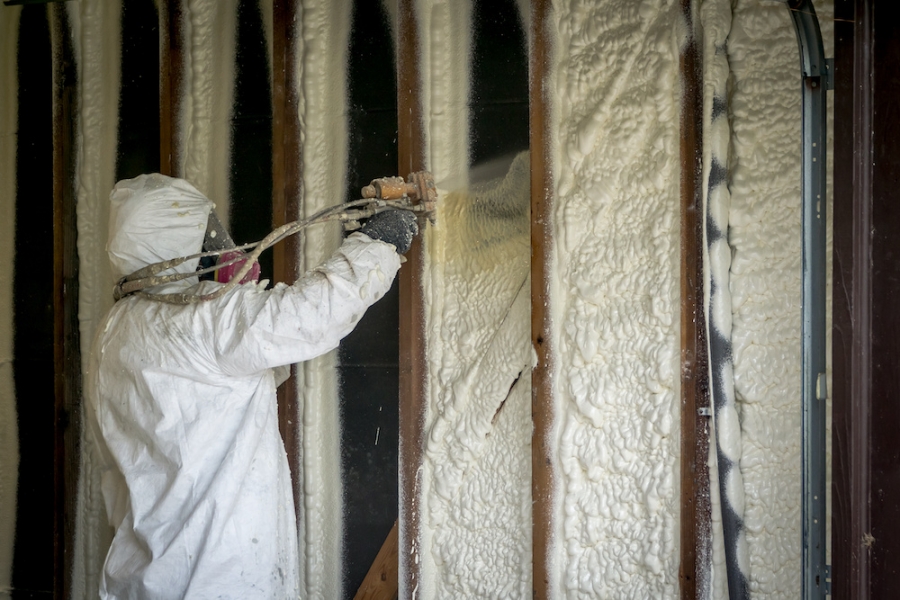
As its name implies, spray foam insulation is a spray typically made of polyurethane. The liquid foam is ‘sprayed’ into areas that need insulation, where it expands to fill the space and hardens over time.
As with cellulose insulation, spray foam also allows you to fill hard-to-reach areas and cover more surfaces. This makes it suitable for areas around light fixtures, electrical outlets, and walls. Once hardened, spray foam will never lose its shape. Unlike other insulation materials like blanket insulation, spray foam will never sag, settle or compress over time.
It can be used in both existing and new construction homes. As long as there are open cavities and good access, spray foam can be installed. And like cellulose insulation, spray foam will require professional installation since it requires specialized tools.
2. Think Of The R-Value
The term R-value has been mentioned many times, but what exactly is it? R-value generally determines the overall resistance of insulation material to heat flow. The higher R-value of the insulation material, the higher its efficiency in maintaining indoor temperature. The right R-value for your home may vary based on your location and climate.
3. Where Are You Insulating?
Another thing you need to consider is the area of your home where you’re insulating. This can help you decide which type of insulation you’ll use.
For instance, if you’re insulating hidden areas with hard-to-reach spaces such as crawlspaces or ductworks, then a spray foam or cellulose insulation can help reach nooks and crannies and ensure maximum insulation. On the other hand, insulating existing walls or attics is commonly done with blanket insulation. If you’re constructing a new wall or room, then insulating it with SIPS or foam board is a better choice.
4. Check For Flammability
Some insulation can be more flammable than others. And the last thing you want is to be worried about the possibility of a fire in your home.
For instance, insulation materials like cellulose tend to be flammable, regardless of whether it is properly treated. Mineral wool is non-combustible. Meanwhile, spray foam insulation is considered combustible.
Take Away
There’s no one-size-fits-all insulation. With various types of insulation available today, choosing the right one for your home can be challenging. After all, improving your home’s insulation is one of the most effective ways to make your interior more comfortable, create a greener home, and save on your energy bills.
Hopefully, the above guide has helped you learn more about your options, allowing you to pick the best one that meets your home’s needs.